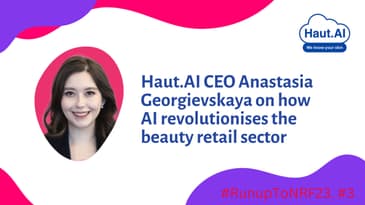
Anastasia, the co-founder, and CEO of Haut.AI, reveals how AI-powered image analysis can revolutionize skincare commerce. Haut.AI’s SaaS platform offers a precise way for beauty brands and retailers to connect with their customers' needs using AI and provide personalized retail experiences. Backed by data-driven, cutting-edge research and technology, Haut.AI is taking tech outside the laboratory and into in-home, retail, and spa settings. In this episode, we discuss what’s behind bespoke AI-created skincare plans and how they let our skins tell their stories!
Give it a listen and let us know what you think?
More about Haut.AI:
Website: https://haut.ai
Twitter: https://twitter.com/hautskintech
LinkedIn: https://www.linkedin.com/company/hautaiskincare/
Instagram: https://www.instagram.com/haut.ai
Facebook: https://www.facebook.com/Haut.Artificial.Intelligence
Blog: https://haut.ai/blog
Email: team@haut.ai
Anastasia interview for Forbes November 14th, 2022: https://www.forbes.com/sites/alexzhavoronkov/2022/11/14/this-female-ai-scientist-quietly-built-a-profitable-longevity-startup-in-estonia-that-is-dominating-the-global-skincare-ai-market/?sh=55c3da2032d5
Podcast Guest
Anastasia Georgievskaya
CEO
Haute.ai
LinkedIn: https://www.linkedin.com/in/georgievskaya/
Email: nastya@haut.ai
Podcast Hosts
Jeff Roster
Twitter https://twitter.com/JeffPR
LinkedIn https://www.linkedin.com/in/jeff-roster-bb51b8/
Website https://thisweekininnovation.com
Brian Sathianathan
Twitter https://twitter.com/BrianVision
Website https://www.iterate.ai
Podcast Website
https://www.podbean.com/pu/pbblog-f8asf-af2782
https://thisweekininnovation.com
Apple
https://podcasts.apple.com/us/podcast/this-week-in-innovation/id1562068014
Spotify
https://open.spotify.com/show/2QDqTUnt6jebdRHbRzSTJN
LaunchPadOne
https://www.launchpaddm.com/pd/This-Week-in-Innovation?showAllEpisodes=true
Listen Notes
#HautAI, #retail, #retailtech, #Skincare, #ArtificialIntelligence, #longevity, #knowyourskin, #skinanalysis, #ai, #beautytech, #thisweekininnovation, #TRI22, #5ForcesOfInnovation, #podcast, #retailpodcast, #emergingtechnologies, #Retailers, #retail, #retailindustry, #retailtechnology, #retailtech, #futureofretail, #innovation, #innovationstrategy, #retailinnovation, #Startup, #Startups, #retailtrends, #retailinsights, #retailnews, #retailtech, #DigitalTransformation, #VentureCapital, #VC, #Founders, #Entrepreneurs, #startupstrategies, #startupfunding, #startupstories, #startupsuccess, #startupfounders, #retailstartups, #founderstories, #founderlife, #Gartner, #IHL,
[00:00:00] Jeff Roster: Well, hello Roy and welcome back to another edition of this Week in Innovation. I I got Brian cornered in his office not traveling somewhere for a day or two, so we can actually have a podcast together. Brian, how you doing today?
[00:00:11] Brian Sathianathan: Doing great, Jeff. It's funny because this is my first video podcast. As we all live in California, wake up quite late and, I had to wake up early and. The usual podcast, I show up with my gym clothes and, because, after pandemic we all it's easier to work in your gym clothes and because it's a video podcast I have to put up, and be ready for it.
[00:00:31] But excited, nevertheless, it's a beautiful, sunny warm day in California and quite excited. The other thing, Jeff we are super excited about having Anastasia here with. Anastasia is a founder of an amazing company called Hot ai spelled as h a u t Hot, right? They have been working with US retailers as well as in a companies in the US as well as in Estonia bit.
[00:00:56] Amazing AI technology, and we are super excited to [00:01:00] have Anastasia here. Anastasia, welcome to the.
[00:01:05] Anastasia Georgievkaya: Well, thank you for having me and nice to meet you today, Brian and Jeff. Very excited to be on the. Ask. Thanks for inviting me,
[00:01:12] Jeff Roster: You're welcome. Looking forward to it.
[00:01:15] Brian Sathianathan: Awesome. Anastasia. Anastasia, why don't you tell our listeners now, actually, viewers about your company heart and also about yourself first and how you got started and what do you guys do?
[00:01:28] Anastasia Georgievkaya: Absolutely. As it was mentioned, I'm the co-founder and CEO of how how is it company operating and beauty and skin longevity space. We came up as actually, you just to maybe explain what does this age a u t actually means? It means skin in German You can read less how you can think of it as hot kutu.
[00:01:50] You can think of it that as hot ai, right? So all of this I think our technology combines, initially we started as software for [00:02:00] research. So the reason why we initially went not to eCommerce or retail, but research was because co-founders both have technical back. So my background is in biophysical research and my co-founder Constantine has a degree in vertical physics.
[00:02:16] But part of, kind of physics is what united us and we felt that back in 2016 when we just came up as the idea, we felt There were not that many solutions that can help you assess your health and balance condition noninvasively, right? So you could pass some blood tests or maybe analyze your dna.
[00:02:34] You would probably wait between two to three months to get your results. So that just didn't feel right. So we felt that there should be some simple, easy, accessible, cheap data that you can use on an everyday. Mrs. Bevin came up with the idea of images, pretty much everyone can take selfie.
[00:02:54] ImageNet dataset just became available around that time. Different neural network [00:03:00] architectures like GPU developed and, that felt, just felt right to go. Under imaging. So first as we are scientists, the think we knew was how to analyze lab data. So we spent around two years working as research organizations for some leading skincare companies testing their creams for effectiveness.
[00:03:19] So we were amazed by the fact. But skincare does work, right? So you look at the before after fact, that skin becomes better, right? So this cream's already doing the job where we're supposed to do. So the question is why generally? Many people think that cosmetics is not working right. Why Many people consider and perceive beauty industry as something which is very heavily marketing driven.
[00:03:44] And just, influencer suggesting you to buy some cream. We started to look deeper into that and we basically realized that there is a lot of synergies with the medical field, right? I will explain how. Consumers are choosing wrong products [00:04:00] or they're not using them as they should.
[00:04:03] So this is why, our skin is not becoming better. So the idea that we came up, So what if we build a technology but can use a selfie to tell a consumer This is what wrong with your skin. We will explain to you why. And this are the product which you should use to make your skin. As it has that, and this is how we came up with how technology and to date we work is around. I think 80 or 85 clients all around the world. We have a great presence in US, Asia, Pacific Region, and Europe of course, and we're serving to all type of customers. So we're serving to clients like Alta or nbi, but also number of small indie brands or even private practices who want to personalize their offerings using how ai, AI technology.
[00:04:55] Brian Sathianathan: Oh, that, that's super fantastic. Anastasia, it's actually, I think it's a really [00:05:00] interesting and a growing area, right? Because I think your cause of the reason. Starting the company. It's really interesting and unique because I think the, it's very hard for people to, and especially with women who are using this hard to explain the why this cream is working.
[00:05:15] And you're using a lot of machine learning and AI to talk about routines, right? That's another area that's always, Vena. Problem as well, because it's hard for people to follow routines and, understand and get personalized beauty care for them. I think this is a super, it's super, super interesting area.
[00:05:31] Tell us about how from a retail perspective, what sort of products are involved in here? What sort of offerings do you have? For other retail customers to, to kinda learn about you. Tell us a little bit about your products and what you guys do in terms of from a products and because you have many different offerings in your company.
[00:05:49] Anastasia Georgievkaya: Yes, absolutely. I would say that applications obviously can be different depending on what's the goal. So as a retailer, do we want to focus on like conversion to sales or do you rather [00:06:00] want to improve retention to your platform, right? So that customers come again, or maybe you want to like raise brand awareness for some of your offerings, right?
[00:06:08] But that pretty much unique and we try to work it really case by case, but generally, I would say, but our technology helps retailers understand exactly what a consumer needs. What does this website needs? Or maybe it can be brick and mortar retail. So here we are offering our computer vision technology for analyzing 150 different facial points and biomarkers.
[00:06:32] So this report can be used to either build customer recommendation logic, or our client retailer can choose to. Feed this information of our algorithms output into how recommendation engine, which will use retailers portfolio and like product inventory to match them to the consumer needs. So first they used our how skin metrics report to identify facial features and then we can also trigger [00:07:00] recommendations using how their recommendation. So this is one of the use cases. So we are providing cloud solution as api, which is very flexible and easy to integrate. But going even further, we wanted to make integration very simple, right? Very simple. So something, but you can set up in two, three hours. So this is why we also now offering
[00:07:20] Brian Sathianathan: We actually with that Dyna, because I think we integrated your APIs in our platform, Drop.
[00:07:33] Anastasia Georgievkaya: Oh yeah. Thank you, Brian. You also have such a great engineering team, so if it took you more than five hours, they would be disappointed. But that, but it was not.
[00:07:41] Jeff Roster: the challenge thrown down.
[00:07:43] Anastasia Georgievkaya: Yeah but genuine. Let's imagine, you are small into brands. You don't have team like brand does have an , but you still want to, you may be a very small retailer. You still want to provide services just in a better way, right? So then you can use how to Skin app constructor. Which is [00:08:00] basically a digit for eCommerce, which you build from templates.
[00:08:03] We provide some web-based interface where you can customize the colors logos to make it feel more like your brand or like more like your business. And then you pretty much put that widget on your website and you start personalizing products. Always no coding. It's no code solution.
[00:08:20] It's quite popular right now versus our, I would say, most popular product. And when it comes to categories, we work across different beauty categories like so skincare, whereas makeup, where is hair, where is body, We're not really working in the makeup. I think you can find much better solutions on the market where we're not coming after.
[00:08:38] So you can, everyone who is in their augmented reality business, you can sleep calmly. But when it comes to like skin and hair, we are offering skin analysis. We're offering hair analysis, and we can, provide descriptive analytics. And even like quantitatively, say, what's the volume of your hair, right?
[00:08:55] What waves do you have? Do you have like currently hair? Do you have kinky hair? Do you, do we [00:09:00] believe that your hair was colored? So all of this information that. consumer to learn more about themselves, but also educate, on what products you need. And recently we decided what we also want to go into aesthetics, oral care, right?
[00:09:15] So the wave is smile is very important attribute, right? So we like send a message to the world. That's why it's also important to, be satisfied with the way you smell looks so I would say the three main categories for us right now are skin, hair, and oral.
[00:09:30] Brian Sathianathan: Super, super, super cool. And also it's really interesting ANDAs Satia. One of the things that, you know, when I, when we spoke to you guys the first time, one of the things we very impressed is that, in your company you guys have this recognition. This is super interesting, Jeff, is that they're not only just looking at themselves as a tech technology company, but they're also having this understanding in their product and offering in terms of how beauty and healthcare emerges, right?
[00:09:55] Because they also have work with pharmacies and other pharmaceuticals and other companies on the medical [00:10:00] side of he. Because today with AI and machine learning, things are getting fairly sophisticated and you can do amazing things with data, right? So you, So they're bringing that experience into the market as well.
[00:10:11] So Anastas, I have a question for you now. Can you explain to the audience how AI and healthcare and the traditional retail in beauty, they're all merging and coming together and you are having this whole, women wanting. Be, have beautiful inside out and wanna be able to like, look at using products in a much more effective manner.
[00:10:28] Tell us.
[00:10:31] Anastasia Georgievkaya: Sure. So I will start at first explaining, Where does medical and aesthetics merge in beauty? So let's think of a skin health overall. So I think that, pretty much every pitch about skincare company starts probably with saying, Oh, skin is largest organ it is. Then it plays lots of important functions, like it's a barrier function, but it also has lots of, it's very.
[00:10:58] Skin is very [00:11:00] communicative. So what I mean by saying that, so because it faces both, outer environment and also like our body internally. So skin is a really good reflector of our health condition, right? Even, unintentionally many people associate with look of the skin, this perceived health and perceived wellness, right?
[00:11:21] So there are lots of research on this topic. The fact that skin reflects and can be, reflective of our health and wellness condition, makes skin as important marker of our health. And at the same time, because skin faces, environment, and it is affected by intrinsic process, it's also a great longevity object, like longevity study model. Compared to other data types it's relatively easy to sample. So you can pretty much use taping. You can make swaps, you can make a picture, you can use sensors, some very like enthusiastic people even can opt in for [00:12:00] bios, right? It's maybe like on an extreme side, but still that's possible.
[00:12:03] So this is why skin is so heavily studied, right? Be because it's easy to sample, because it's very informative. Then it comes to this is where like beauty and mixed longevity, right? So it is also you will be surprised to know that higher perceived age, so that the age that other people think you are in some studies was shown to be associated with higher mortality and also this higher rate of cardiovascular diseases, right?
[00:12:30] Then if I think of skin in the context of.
[00:12:34] Jeff Roster: it's
[00:12:34] Anastasia Georgievkaya: So maintaining healthy skin, like it's good functions, like it's good lipid barrier, it's good protective functions. It's important for, not to be like, affected by different aggressive factors. For example, particle matters or toxins or any pollutants.
[00:12:51] Even you'll be radiation.
[00:12:53] Jeff Roster: stuff.
[00:12:54] Anastasia Georgievkaya: So this is why when we. Take care of our skin, right? So no, no doctor will give you [00:13:00] any medicine to make your healthy skin healthy, right? But what skincare companies can offer you a cure to build skin resilience, right? So instead of trying to cure skin diseases or, fighting aging features like hot mentation and wrinkles, why don't we rather focus on tune resilience, right? As an example, skin has a very strong connection to gut health, and it is believed that gut health has such a big impact on skin because gut regulates our immune system. So when we have healthy lifestyle and we have healthy immune system, also our skin will be healthy. We protect it with screens and we are no small cracks, we use sun tanning, so we take less photo damage and we can use some topical antioxidants to also reduce, for example, reactive oxygen species. So all of that makes our skin healthier. So how can you know what's the role of skincare? Because [00:14:00] you do skincare every day. You don't apply, medicines on your skin every day, hopefully. So that's why, by taking care of your skin on a daily basis, you are really building it's skin resilience.
[00:14:10] So it's like it can react to all of the damages and it can fight them. And this is why your overall health improves, because you improve the barrier function of your.
[00:14:21] Brian Sathianathan: Wow. That is super cool. Jeff. Isn't that cool? never thought of it like that way.
[00:14:27] Jeff Roster: so Anastasia, I'm my skin was. Evolved for the Scottish Highlands, and I've lived in California my whole life. So I let me just tell you the idea of aging and the medical aspect of scanning for skin cancers is really important to me. Is that, is your technology at that level where, I go in every six months now at my age to to have that medical procedure where, a dermatologist has to look over and look for any little lesions or whatnot.
[00:14:51] Are, Have you evolved to that point where that's something that your technology will get to, or is that something you want to go after? At some point?[00:15:00]
[00:15:00] Anastasia Georgievkaya: Well, it probably will sound quite funny, but this is where we started from initially. So before we went into aesthetics, we worked on melanoma recognition and also some other image data, for example. I found those. Scans or psoriasis and keratosis. We eventually decided to, focus on aesthetics because this is something we do best, right?
[00:15:23] Again, there are many companies who like work specifically on melanoma or different other skin cancers, right? They will you much better solutions than we are. We are focusing on skin, balance, skin. right? If we still can analyze skin eruptions, right? And different skin lesions, right? And for example, we can tell if we believe this lesion were to be shown to a doctor, but we will not perform any like medical diagnostics or any triage.
[00:15:54] So we are rather approach, but from the preventive perspective, right? So we see some signs that [00:16:00] alarming, and this is why we suggest you consult with a profess.
[00:16:04] Jeff Roster: But that's where we're going at this point, where whether it's your technology or just that technology space that you're sitting in, that we'll literally be looking at our, our skin on a daily basis. And then if something pops up, which, again, if you went to the dermatologist where I go to in San Jose, you see a lot of.
[00:16:21] That clearly of my, my agent older, that we didn't have that concept of skincare. And by the way, mostly men that didn't have that concept of skincare that are now having stuff cut off, on a monthly and yearly basis. So that's where this is evolving to of being far more forward looking, catching things before they become a bigger issue.
[00:16:38] Wow, that's amazing.
[00:16:41] Anastasia Georgievkaya: Absolutely, You're completely right. There's still lack of education right on the health topic in different, spaces but in skincare as well. And it's quite hard to say by the situation, like why we live in this situation, but I would genuinely say that there is a big scarcity of [00:17:00] dermatology care, right?
[00:17:01] So we're like the number of doctors per million of population in us. In Europe it's pretty low because dermatological training is very, Hard. It's like it takes lots of time. You really need see a lot of patients and usually general practitioners where have very limited training. This is why we need tools like how, but you can, scan on a daily basis exactly what he mentioned, see this early signs and don't wait long enough, to make this sign turn into real.
[00:17:32] Jeff Roster: Wow, that's amazing. Now. Initially as you were talking, I was thinking this was more targeted at women. But the second you start talking about skincare, I everyone has skin. So is this, how are you targeting your solution demographically mostly towards a female audiences or are popping over to the other 50% of the population?
[00:17:50] Anastasia Georgievkaya: We're very inclusive, where like our solution is for everyone, right? And we're different technical approaches to enable that. First obviously [00:18:00] men are different because we have facial here, and that's quite often why computer vision system fail, right? Because they see. Beard and facial here, and they believe this is some artifacts or they can consider thiss like hyperpigmentation spots and produce false positive or false negative results.
[00:18:14] To fight with that, we basically developed the technology, which we call Skin Atlas, that eliminates all information on the face, which is not related to skin, so which is also includes your like eyebrows or facial hair, or. Here, like generally here because it can also produce false positive results and it at the same time, it only minds this image.
[00:18:38] So the benefit of using this technologies, but we also decrease the dimension of image file. So you know, it can be processed faster for results and lower cloud cost because basically it's the faster protesting time, the less we pay for the cloud provider, which maybe we're not so happy about.
[00:18:53] Then once we have this anonymized picture by making the calculations. From skins. [00:19:00] Zen. Just last month I published my first single offer research paper in the Journal of Plastic Reconstructive Surgery, which specifically talks about the differences we see in males and females because males and females naturally.
[00:19:15] Have different skin properties heavily controlled by hormones, right? So for example, men generally have higher level of redness because they have high concentration of hemoglobin than also men have genuinely higher level of skin pigments and like generally have a more intense skin tone. So the way to approach that from technology perspective is to. population specific and population group specific scales, right? So what you do, like you, you basically, you can use same algorithms, right? You just need to ensure that they were trained on like diverse dataset, which is reflective of your population, right? So if you are retailer in us, like you can't only like train on Caucasian data, right?
[00:19:57] But absolutely makes no sense, right? This is why [00:20:00] the topic. Inclusive ai non-discriminating high is becoming more and more popular in Europe. We even going to have regulation AI act specifically focusing on AI aspects and non-discriminating high, but getting back to like differences for males and females.
[00:20:16] But basically say that we measure like the distributions on population group and then we just know what. Are relevant for men and which scores are relevant for females. And again, you can use same algorithm because the algorithm analyzes factual features. For example, when it comes to wrinkles, analyzing per like surface of skin or face covered by wrinkles and ver depth, right?
[00:20:36] And it's objective measure, but just, where level of manifestation will be different from males and females. So I would say you can use our te. If you are like whatever gender you are and still get relevant recommendations and relevant results.
[00:20:50] Jeff Roster: Wow. That's pretty amazing. I as somebody that's gonna benefit from having, faster, more observing of, melanoma, whatnot, I, I can't encourage this this research enough. [00:21:00] How do you. How do you deploy? So are you, do you, would a retail, first of all what sub sectors do you work in?
[00:21:06] Clearly, beauty and health. Any other, Actually probably general retail that has aspects of beauty. Every, so anywhere where there's a, be any retail that has a beauty offering it, your solution would be appropriate. Then I take it right.
[00:21:20] Anastasia Georgievkaya: Well, yes. Exactly. We are now considering, you expansion to other spaces. So we're not only working with retail, but also working this plastic surgeons, obviously because they need the SA skin. But then we believe that, understanding your. Signature, right? So your skin tone can be even helpful to match clubs, right?
[00:21:41] Do you have cold skin sub tone or do you have warm, right? What's your perceived age like? What's the color of your eyes? Do you have freckles? Because all of these features that make you, you right can be also used to personalize your. . Or a a. Any [00:22:00] other things like I like, maybe you want to analyze facial biometrics to also understand what kind of glasses will work best for you.
[00:22:09] Jeff Roster: Wow. So let
[00:22:11] Brian Sathianathan: why I think, Jeff, this is super interesting and what Anastasia and team are doing at heart is very unique is because they are looking at it in a very comprehensive. Looking at the facial, the 3D list, the face atlas, and identifying skin and writing, building the right models, and also making it unbiased and making it more inclusive.
[00:22:29] But at the same time, the applications are numerous across several fields when you do it right. Because the challenge in AI traditionally now is a lot of open data sets and things that are out there, have heavy bias towards in them, right? Because they're all like, built by universities and whatever the data they can get their hands on, people have built it right?
[00:22:47] Because this is an emerging field, but, companies like Heart and Anastasia's team and others are looking at like, how do you make this better? How do you build like really unique because they bring, also bring the industrial health [00:23:00] experience as well into beauty which I think is super interesting and kinda widely applicable across retail in.
[00:23:05] Jeff Roster: So Anastasia, I wanna make sure I understand that point you made though. So having a better understanding or a perfect understanding of somebody's face in skin tones, impacts recommendations in apparel, in clothing.
[00:23:21] Anastasia Georgievkaya: Well, yes
[00:23:22] Jeff Roster: that what you said?
[00:23:22] Anastasia Georgievkaya: Exactly. And then you explain, where's it coming from? It's not just because you know how it wants to go into new markets, and this is why we say, Oh, basically it's very good feal, but in fact, There are some rules in our field, right? For example, if you are participating in a clinical test of any skincare, you're making pictures, right?
[00:23:42] You shouldn't use any bold colors as your background. For example, green or red, or very like pure netty blue, I wear actually like something like I shouldn't wear for skin analysis because colors also change perception of skin features. And [00:24:00] even like neural networks can be confused if we like, if they see this bold colors.
[00:24:05] Of course, if you're using skin atlas, it's not the issue because if we basically eliminate all of this, but. If I think of, what forms the way our skin looks, it's like the color of skin is like very free volume, texture, and color. Color is one of them. So this is why understanding facial features can be helpful for your outfits as well.
[00:24:25] And also whereas theories of kind of user groups and like user cluster. That's more like psychological side of things, but you should remember, but skincare is also very heavy link to psychology, right? So it's very important, what to think of ourselves, how we perceive ourselves, how we think us as perceive ourselves, right?
[00:24:50] So this is why I believe this is where skin care is similar to fashion. There's a very strong psychological c.
[00:24:58] Jeff Roster: Wow, real [00:25:00] interesting. Let me ask a couple analyst questions. So where would this technology sit? Is this or Brian, jump in too. So it's clearly AI driven and machine learning, computer vision. So those are pieces of technology, But is it is this a, would you put this in bi or, in my forecast budget, Brian where would this sit?
[00:25:17] Brian Sathianathan: This would actually sit in a couple of areas. One is AI based recommendation systems, right? AI based AI based virtual tryon systems, right? AI based skin, and also parts of the offering. That's why the company is very unique. Parts of it is like existing kind of space, but there is a whole series of things where.
[00:25:36] Converging with medical stuff which is not even in the traditional radar, which is just kinda an emerging area,
[00:25:43] Anastasia Georgievkaya: well, I'd also like to add that. Actually also helping companies conduct, like with web marketing. I will explain how, imagine you are like selling your products on the market and you launched a tool to analyze skin of your consumers. So [00:26:00] basically why our customers love our tool is because we are also providing analytics and we are now building more sophisticated, more advanced product because you can basically understand what are the real concerns of your consumer.
[00:26:14] Let's say you are a brand that focuses on skin clarity, right? You want to have skin riches, spots free or like ethnic eruptions free, and this is like the audience you're targeting. Then you analyze the actual data, right? And that the concerns with your consumers have, I don't know, like I bags or sagging. So basically every branch like a brand and visitation should ask themself, do I have the right targeting, right? Why do I. Consumers, who have different concerns, not the ones I'm focusing on. So should I maybe consider offering them products that they need? Maybe I should expand my portfolio, or maybe I'm doing my targeting wrong, so maybe these people can face, but for example, we didn't buy the products because it [00:27:00] doesn't answer the questions.
[00:27:01] So we will like, I believe, Also to achieve sustainability because beauty industry is unfortunately not sustainable. I can't say it's like really sustainable, of course, but there is lots of very positive developments like new packaging, transparency in the supply chain, but still, we're not there yet. So understanding exactly what products your consumers need.
[00:27:24] Database like data driven. Evidence based is exactly, where the industry should go. And I believe that every skincare brand, the retailer should also consider tools like how to better sense skin concerns and skin needs of the consumers to be proactive.
[00:27:45] Jeff Roster: Okay. Yeah, so I like that Brian. I think that recommendations make sense. AI driven recommendations. Sounds like there's a marketing play there too. Boy, there's gonna be a lot of different. Places where this is gonna sit. Hey Anastasia, we, as we start to wrap up, both Brian and I are [00:28:00] fathers of daughters.
[00:28:01] Mine happens to be a little bit older than Brian's, but both of us wanna make sure our daughters are exposed to technology. Just curious, what advice would you have for fathers of daughters to
[00:28:11] Brian Sathianathan: And also for daughters as well, both. It's a two, two-pronged question, right? What advice would you have for fathers, and what advice would you have for.
[00:28:18] Jeff Roster: Good. Brian's still in the fight. I'm, my daughter's 25, so I, I'm probably sitting this one out, but Brian is our prime candidate. So what how would you, what, you're obviously, deep into stem and really on the cutting edge of some really interesting stuff. What advice would you give for us?
[00:28:34] Anastasia Georgievkaya: Well, I maybe will first tell, genuine advice for the kids. I think it, I don't have kids myself. But I remember my father would always, make some kind of physics or electronic experiments with me. Every weekend he would come up with something new. So I think it's very important to spark interest, in children, not just pushing them into studying something, but really like showcase.
[00:28:56] But technology is cool, right? And it can be very different than [00:29:00] the, it can be. And I believe that, remembering me as a child, a lot of things I remember, a lot of positive memories. There's like kind of different experiences, right? I don't really remember, I don't know, watching some movie or like cartoon, but I do remember doing lots of stuff with my parents.
[00:29:17] So this is maybe something I would recommend to parents, and this is like what I believe made me interested in natural. Then talking about what advice I probably would give specifically to dads who have beautiful little girls or maybe not as little like more on the toddler side. I would genuinely say that.
[00:29:37] Maybe explain to them that there is. . In fact, there is no such thing, like something for girls, something for boys, right? So this is this is artificially, it's not like engineering is not for girls, right? And you should play toys. Or maybe it's not like coding is for boys, right? It's maybe just the way things used to be before, right?
[00:29:57] But, before women didn't [00:30:00] wear jeans, right? So that, that doesn't mean that this is really. Things are just not putting the labels right. You can do whatever you like, right? And don't think this is something for boys exclusively and same for boys, right? So beauty if don't tell your like, boy, but, but beauty feel that, it's something for girls because it's like really hardcore coding, right?
[00:30:23] So you basically need to build solutions which are scalable but can handle, Black Friday, Cyber Monday. Load and not crash. This is like the real infrastructure. It's really technically advanced and it's it's a really cool place to work for anyone.
[00:30:40] Jeff Roster: Excellent. What advice would you have for young entrepreneurs? Just getting started.
[00:30:43] Anastasia Georgievkaya: I would say that it's hard to be an entrepreneur. It's hard to do something that you know you do first time or do something maybe that no one did before. So I think it's really important to have mentors. It's really important, to find people who [00:31:00] believe in you, right? Who can brainstorm with you who.
[00:31:04] We'll be able to provide you some piece of advice, right? And there are many ways how you can meet platforms throughout different platforms, whereas lunch club, there's a lot of networking platforms through a lot of pitch competitions and angels who are specifically looking for, startups or young scientists.
[00:31:21] So I would say, Especially like maybe for technical founders, it's sometimes maybe hard to socialize, right? But you still have to do that, right? It it doesn't mean you will be absolutely comfortable with that, but you can't really be like locked in your box, right? You really need feedback. You need mentors, especially you for startup.
[00:31:38] Maybe if you're building the, you already know how to do that because he did it four times before. Then second question, I think that quite often startups don't.
[00:31:45] I especially again in stem, I think that we believe that, marketing is not really important, right? We will just do our excellent coding and we will build very advanced tech in marketing.
[00:31:55] It's for companies that don't have great technology, which is I think is a very big trap, [00:32:00] right? Your potential customers, investors, users, they need to know that, this technology exists, right? So you should never say that marketing is not important. It is very important.
[00:32:11] Jeff Roster: Well, that's our, yeah, that's our battle cry at at this week in innovation is to really give a platform for young startups to, to begin to talk and to interact with thought leaders and whatnot. Yeah. Love, love hearing that. What skills
[00:32:24] Anastasia Georgievkaya: And thank you for doing this great job
[00:32:26] Jeff Roster: We're working on it, we're learning. Just trying to figure out the whole video aspect of an audio podcast has been has been like the last two months of my life. What key skills that you use now do you wish you would've paid more attention to back in the early part of your career?
[00:32:38] Back in college? Or right at your start?
[00:32:40] Anastasia Georgievkaya: I actually, this is something I couldn't think quite often about because, I was focusing on biology and biophysics. I had lots of maths and physics. But then shifting, to different discipline, which is like machine learning can really feel that math is so important, right?
[00:32:56] So fundamental understanding of how things work, [00:33:00] like in like how algorithms work, what's the complexity of different algorithms it really helps. Because from the engineering perspective, it's just very relevant knowledge. So I regret maybe studying math, not as hard as I should have. On the other hand, you can't be, absolutely professional or know everything, right?
[00:33:20] So I would say that know that maybe I would do more of that, but at the same time, I can't go back. So this is just I need to embrace that. Genuinely I feel like. I always tried, to understand like how things work, right? That doesn't matter what. This is, I think what was important in learning, like learning how to learn and this is what I continue doing every day right now.
[00:33:39] Jeff Roster: Yeah, that's great. Advi. Learning how to learn by the way. Lot. I'm a lot older than you and I work on that on a daily basis. Learning how to learn and being open to new learning would be the next, would be the next great thing. Wow. What a fantastic 35 or so minutes we spent together.
[00:33:52] Just wish you the best. Just the best of luck. I very much encourage anything related to skin cancer research, so I'm a personal fan of [00:34:00] anything there. Just sounds fantastic. Anastasia, how would people get in touch with you retailers or anybody that would might wanna reach out?
[00:34:06] Anastasia Georgievkaya: So I highly encourage everyone to connect with me on LinkedIn or, drop me a message. So basically my email is nice to how I, which is like N A S T Y a Zen like our domain. How. Just, I'm very active in not very active, but I'm always on social media, always respond. So just, connect with me on LinkedIn will be like the best option and happy to take it from there.
[00:34:30] Jeff Roster: Great. Well, thanks so much for taking the time today. Wish you the best of luck and Brian sounds like you.
[00:34:36] Brian Sathianathan: Yeah, as well. It was fantastic.
[00:34:38] Jeff Roster: I look forward to Brian's weekly physics projects with his very smart young daughter.
[00:34:42] Brian Sathianathan: No. I dunno what to do. Absolutely.
[00:34:44] Jeff Roster: needs, that might be a whole separate podcast. Brian's journey into tech or into stem.
[00:34:49] I dunno something along that
[00:34:50] Brian Sathianathan: me for daughter.
[00:34:52] Jeff Roster: That actually would be, that actually might be fun. We might have to think about that. Thank, thanks for that idea. Anastasia. Terrific. Well, thanks
[00:34:58] Brian Sathianathan: with just said, we'd [00:35:00] love you, but good luck on you're, I you're entrepreneurs. Truly changing . Awesome.
[00:35:08] Anastasia Georgievkaya: you so much. Thank you so much.